Ultimate tensile strength (UTS) is one of the most important mechanical parameters in materials science. It characterizes a material’s maximum resistance to failure under tensile stress. This critical indicator plays an important role in the design of technical components and structures, material selection, and ensuring safety in industry.
Determination of tensile strength
The ultimate tensile strength (UTS) is the maximum stress a material can withstand in a tensile test before failure . It is measured in megapascals (MPa) or pounds per square inch (psi) and represents the highest point on the stress-strain curve.
Important points:
-
The UTS point is located behind the yield point.
-
After reaching the UTS, the subject enters the “tight” phase.
-
The tensile strength is always greater than the yield strength (except for brittle materials).
Method for measuring maximum resistance
Standard tensile test (ASTM E8)
-
Prepare a standard sample (usually in the shape of a dumbbell).
-
Place the sample in the tensile testing machine.
-
Applying a tensile load at a constant speed
-
Plot the stress-strain curves up to the point of failure.
-
Enter UTS as the maximum recorded voltage.
UTS account:
UTS = F_max / A₀
Where:
-
F_max: Maximum recorded power
-
A₀: Original cross-sectional area of the sample
 Factors that influence maximum endurance
1. Chemical composition
-
Alloying elements such as carbon in steel increase tensile strength.
-
Impurities tend to reduce UTS.
2. Crystal structure
-
Grain size: The finer the grain size , the higher the UTS.
-
Dislocations and defects in crystals
3. Production process
-
hard work (cold work)
-
Heat treatment (hardening, annealing)
-
Forming processes (rolling, forging)
4. Environmental conditions
-
Temperature (the maximum temperature usually decreases with increasing temperature)
-
corrosive environment
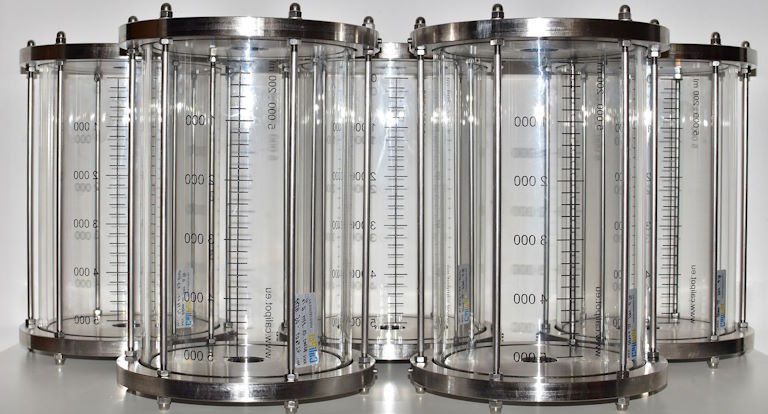
Henco DDC calibration cylinder
Comparison of UTS results between subjects
Metal:
-
Structural steel: 400-550 MPa
-
Carbon steel: 850–1200 MPa
-
Aluminum 6061-T6: 310 MPa
-
Pure titanium: 550 MPa
-
Pure copper: 210 MPa
Polymer:
-
Polycarbonate: 55-75 MPa
-
Nylon 6: 45–90 MPa
-
PTFE (Teflon): 20-35 MPa
Composite materials:
-
Carbon fiber/epoxy resin: 600–1600 MPa
-
Kevlar fiber: ~3000 MPa
The importance of the University of Technology Sydney in engineering
1. Security design
-
Determine your trust level
-
Prevent catastrophic failures
2. Material selection
-
Adaptation of material properties to project requirements
-
Improve weight and strength
3. Quality control
-
Confirmation of incoming material specifications
-
Monitoring the production process
4. Predicting human life expectancy
-
Assessment of fatigue resistance
-
Overall damage analysis
Relationship between tensile strength and other mechanical properties
1. Limits of flexibility
-
Typically, the tensile strength is about 10 to 50% higher than the yield strength.
2. Expansion
-
Materials with higher tensile strength generally have lower elongation.
3. Flexibility
-
The hardness depends on the tensile strength and elongation .
4. Hardness
-
There is an empirical relationship between hardness and tensile strength.
Industrial application
1. Automotive industry
-
Selection of materials for the main components
-
Improved weight and safety
2. Construction
-
State the technical properties of structural steel.
-
Construction resistant to force
3. Aerospace industry
-
Lightweight material with very high UTS value
-
Design of load-bearing elements
4. Oil and gas industry
-
High-pressure pipes and fittings
-
Resistant to harsh conditions
Related standards
-
ASTM E8/E8M : Standard for Tensile Tests on Metals
-
ISO 6892-1 : International Standard for tensile tests
-
DIN 50125 : Standard for tensile specimens
-
JIS Z 2241 : Japanese Standard for Tensile Strength Tests
Ways to improve your UTS
1. Alloy
-
Addition of alloying elements such as carbon, chromium and nickel.
2. Hard work
-
Cold plastic forming (rolling, stretching)
3. Heat treatment
-
Softening, aging, glowing
4. Modification of the microstructure
-
Grain size control, sediment phase
5. Use of composite materials
-
A combination of ingredients with complementary properties
UTS restrictions
-
The actual behavior of the material may be more complex.
-
Fatigue must be taken into account in the dynamic design.
-
This is not an ideal standard for fragile materials.
-
The influence of environmental factors can be overlooked.
Finally
Tensile strength is a fundamental parameter in materials science and plays a crucial role in the development and selection of materials. A better understanding of this concept and the factors that influence it enables engineers to develop safer and more cost-effective materials. Despite modern technological advances, the development of materials with higher tensile strength remains a major challenge in materials science.
Frequently Asked Questions
1. What is the difference between tensile strength and actual tensile strength?
The calculation of the tensile strength is based on the initial cross-section, while the actual breaking strength takes into account the current cross-section.
2. Why is UTS technology alone not sufficient for design?
Because there is no information about the behavior of the material after creep, plastic deformation and hardness.
3. How does temperature affect UTS?
In general, the UTS decreases with increasing temperature (except for some special cases).
4. Why do high yield strength (UTS) materials tend to have reduced ductility?
Because their plastic deformation mechanisms are more limited.
5. How can you estimate tensile strength without conducting a tensile test?
By hardness testing and using the empirical relationship between hardness and UTS (e.g. for steel: UTS ≈ 3.5 × Brinell hardness).