Volume measurement is a fundamental and important concept in physics, chemistry, and engineering. Volume is the space occupied by an object or substance. Measuring any substance, whether liquid, gas, or solid, requires specialized methods and equipment. Understanding these tools helps us conduct more accurate scientific experiments, improve quality control in various industries, and make more precise measurements in everyday life.
What is the concept of size?
Simply put, volume is the amount of space an object occupies. The basic unit of volume in the International System of Units is the cubic meter (m³), but the liter (l) and milliliter (ml) are also commonly used in laboratories and everyday work . One liter equals one thousandth of a cubic meter (1 l = 0.001 m³).
Depending on the type of substance (solid, liquid or gaseous), different devices are used to measure volume.
1. A device for measuring the volume of liquid
Because liquids are malleable and moldable, they can be measured with instruments that indicate their precise volume.
a) Measuring cylinder
One of the most commonly used laboratory instruments for measuring the volume of liquids is a graduated cylinder. This is a vertically arranged container made of glass or plastic, graduated to a specific volume.
-
Accuracy: very high
-
Application: Measuring the approximate volume of liquids.
-
Note: To determine the correct size, the spirit level must be read along the line of sight and from the lowest point (crescent) of the contour line .
b) Biuret
A biuret is a long, thin tube with a control valve at the bottom that is used to gradually add liquid in experiments such as titrations.
-
Accuracy: very high
-
Application: Analytical chemistry and microbiology.
c) Absorbent
A pipette is a glass or plastic tube that can be used to collect and transfer a specific amount of liquid.
-
Type: graduated pipette, measuring pipette
-
Application: For laboratory work that requires high precision.
d) Volumetric flask
Volumetric flasks are used to prepare solutions of a specific concentration. A line on the neck of the flask indicates the specific volume after filling with liquid to a certain level.
-
Features: Very accurate
-
Application: Preparation of standard solutions in the laboratory.
d) Measuring cup
In everyday life, especially in the kitchen or food industry, measuring cups are used to measure the volume of liquids such as water, oil or milk.
-
Units of measurement: milliliter, cup, tablespoon
-
Application: Fast measurements outside the laboratory.

2. Gas volume meter
Measuring gas volume is more complex than measuring liquid volume because gas volume depends on pressure and temperature. It requires specially designed equipment.
a) Gas syringe
It is a syringe-like device that can be used to measure the volume of gas produced during a chemical reaction .
-
Application: Measurement of gases produced as a result of reactions in chemical laboratories.
b) Gas volume scale
This device is used in industry or gas plants to measure the amount of natural gas flowing through a specific point .
-
Type: dry volume meter, wet volume meter
- Application: Industrial and private applications, for example in gas meters.

3. Volume measurement of solids
For objects with regular shapes (such as cubes and cylinders), volume can be calculated using geometric relationships. For irregularly shaped objects, indirect methods must be used.
a) Geometric formula
If the object has a regular shape, use the following formula:
-
Cube: Volume = Side length x Side length x Side length
-
Cylinder: Volume = π × radius² × height
-
Domain: Volume = (4/3) × π × radius³.
b) Shift method
To measure the volume of irregularly shaped objects, you can use Archimedes’ principle. In this method, the object is placed in a graduated cylinder filled with water. The change in the liquid level indicates its volume.
-
Application: Physics and chemistry lessons in school.
-
Features: Simple, precise, suitable for small items.
4. Modern digital instruments for volume measurement
With technological advances, digital tools are replacing traditional methods.
-
Digital flow meter: Used to measure the volume of a liquid flowing in a pipe.
-
Ultrasonic volumetric meters: Use sound waves to non-contact measure the volume or flow of liquids and gases.
-
Automation systems in the pharmaceutical and food industries: Use of precise volumetric systems for filling bottles or containers.
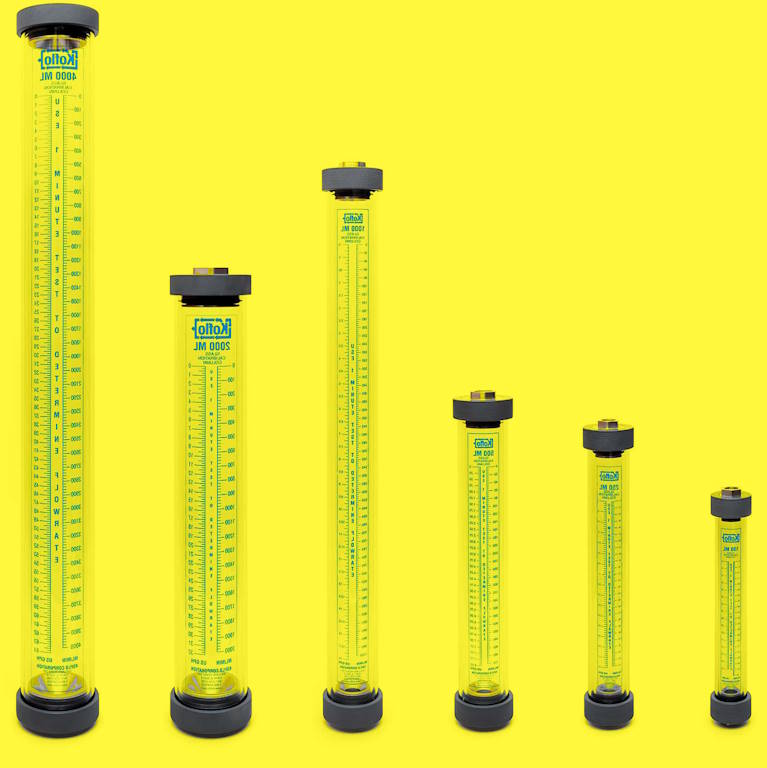
Henco DDC calibration cylinder
5. Precautions when using measuring instruments
-
Temperature and pressure affect volume, especially the volume of gases.
-
The viewing angle when reading the liquid level should be horizontal to avoid parallax errors.
-
To ensure accurate measurements, always use clean and dry equipment.
-
Use appropriate equipment for each type of experiment, such as a biuret for titration and a volumetric flask for preparing solutions.
-
Use calibrated and standardized instruments to reduce measurement errors.
6. Application of volume measurement in everyday life and in industry.
-
Medicine: Measuring the dosage of liquid and injectable medications.
-
Food industry: control of raw material quantities
-
Engineering: Design of piping, fuel supply and ventilation systems.
-
Environment: Measuring the amount of harmful gases or wastewater
-
Research and teaching: Teaching the fundamentals of physics and chemistry
Finally
Volume measurement is a simple yet important concept in science and industry . Selecting the right instrument is crucial and depends on the type of material, the required accuracy, and the environmental conditions. From a simple graduated cylinder to a modern digital volumetric meter, each instrument plays an important role in science and engineering.
A good understanding of how these devices work not only helps us make more accurate measurements but also allows us to better appreciate the importance of scientific details in our daily lives.