Duplex 2205 stainless steel is one of the most widely used stainless steels in modern industry, combining high strength, excellent mechanical strength, and exceptional corrosion resistance. This advanced generation of austenitic and ferritic stainless steel grades has replaced conventional steels in many industrial applications, including the oil and gas, petrochemical, refining, and food industries.
In this article, we provide a comprehensive overview of duplex steel 2205, its chemical composition, physical and mechanical properties, manufacturing processes, and main applications.
What is duplex steel?
Duplex stainless steel is a type of stainless steel whose microscopic structure consists of two phases: austenitic and ferritic . This combination allows the properties of both steel types to be combined in a single structure. This results in the high strength and stress cracking resistance characteristic of ferritic steel, as well as the toughness and ductility characteristic of austenitic steel.
The name “Duplex 2205” is derived from the approximate ratio of chromium (22%) to nickel (5%) in its chemical composition.
Chemical composition of duplex steel 2205
The following table shows the approximate chemical composition of the alloys:
| component | Weight percentage (%) |
|---|---|
| Chromium (Cr) | 21.0 – 23.0 |
| Nickel (Ni) | 4.5 – 6.5 |
| Molybdenum (Mo) | 2.5 – 3.5 |
| Manganese (Mn) | ≤2.0 |
| Silicon (Si) | ≤1.0 |
| Nitrogen (N) | 0.08 – 0.2 |
| Carbon (C) | ≤0.03 |
| Iron (Fe) | He spends |
The presence of molybdenum and nitrogen in the steel structure is the main factor that increases its corrosion resistance, especially resistance to pitting and crevice corrosion.
Mechanical properties of duplex steel 2205
Due to its duplex microstructure, this steel has significantly higher mechanical strength than austenitic stainless steels such as 304 or 316.
| own | approaches |
|---|---|
| Tensile strength (UTS) | 620 – 880 MPa |
| The power of submission | ≥450 MPa |
| extension | About 25% |
| density | 7.8 grams per cubic centimeter |
| Hardness (HB) | about 290 |
| Operating temperature range | up to approx. 300°C |
Simply put, duplex steel 2205 is twice as strong as 316 stainless steel while offering greater corrosion resistance.
Important chemical and physical properties
-
Excellent resistance to chloride corrosion:
Alloy 2205 exhibits very high resistance to pitting corrosion and stress cracking in environments containing chloride ions. -
Good heat resistance:
Can be used at temperatures up to 300 °C without significant loss of mechanical properties. -
High hardness at low temperatures:
Unlike ferritic steel, it retains its good strength and ductility at sub-zero temperatures. -
The coefficient of thermal expansion is lower than that of austenitic steel:
this property ensures greater dimensional stability during temperature fluctuations. -
Good weldability:
Although they are slightly harder than austenitic steels, high-quality welds can be achieved with proper electrode selection and heat control.
Technology of production and forming of duplex steel 2205
The production of duplex steel requires precise control of temperature and chemical composition during melting and heat treatment. Key production steps include:
-
Melting and refining: Carried out in an electric furnace with control of the composition of the alloying elements.
-
Continuous casting: Used to produce ingots or metal parts.
-
Hot and cold rolling: for the production of sheets, bars or tubes
-
Solution annealing: at approximately 1050–1100 °C, followed by rapid cooling to obtain the duplex structure.
-
Finishing operations: such as cutting, polishing or painting to improve the strength of the surface.
Standards and awards
Duplex steel 2205 has different names in different standards:
| standard | Equivalent name |
|---|---|
| United Nations | C32205 / C31803 |
| American Society for Testing and Materials | A240, A789, A790, A928 |
| He is there | 1.4462 |
| Noise | X2CrNiMoN22-5-3 |
Applications of 2205 duplex steel
Due to its unique properties, this steel is used in various industries. Key applications include:
1. Oil, gas and petrochemical industry
Duplex steel 2205 is used in mining equipment, piping, heat exchangers, and pressure vessels exposed to seawater or chemicals .
2. Marine and coastal industry
This steel has high resistance to saltwater corrosion and is used in the manufacture of propellers, ship structures and seawater systems.
3. Food and pharmaceutical industries
Due to its resistance to oxidation and repeated washing, it is ideal for process systems that come into contact with acids or cleaning solutions.
4. Water treatment plants and desalination plants
It is used in seawater pipelines and desalination plants where ordinary steel is subject to severe corrosion .
5. Pulp and paper industry
It works well in contact with corrosive chemical solutions such as chlorine and sodium hypochlorite.

Advantages of using duplex steel 2205
-
High mechanical strength and consequently low weight of the structures.
-
Excellent corrosion resistance, even in chloride and acidic environments.
-
More durable and requires less maintenance than conventional stainless steel.
-
Resistance to chloride stress cracking (SCC)
-
Excellent welding and machining skills in compliance with technical principles.
-
Durable, fully recyclable and environmentally friendly.
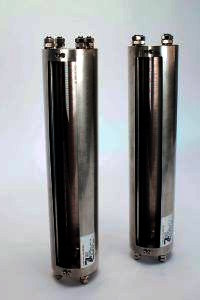
Sigmamotor PVC calibration cylinder
Limitations and possible uses
Although duplex steel 2205 is widely used, it also has some limitations :
-
At temperatures above 300 °C, secondary phases (e.g. sigma) can form, which can impair the mechanical properties.
-
The welding process requires precise control of pre- and post-heating.
-
It is more expensive than traditional stainless steel, but due to its longer lifespan, it is more cost-effective in the long run.
The difference between 2205 duplex steel and 316L steel
| Special feature | Steel 2205 | 316L steel |
|---|---|---|
| Tensile strength | Over (≈800 MPa) | approx. 550 MPa |
| Resistance to chloride corrosion | very good. | half |
| Price | Just a little bit more | fewer |
| Operating temperature range | Up to 300°C | Up to 400 °C |
| Welding options | A little more complicated | Just take it |
For this reason, duplex steel 2205 performs significantly better than steel 316L in corrosive environments or when in contact with seawater.
Finally
Duplex steel 2205 combines austenite and ferrite, offering a unique combination of mechanical properties and corrosion resistance. This has made it a popular alternative to conventional stainless steel in many strategically important industries.
If you are looking for strong, durable and cost-effective steel for your industrial project , Duplex 2205 steel may be the best choice because of its high strength, reliable performance and low maintenance costs.